
Contact Us
Social Media Toolkit
No Longer the Alternative!
As we work to expand Alternative Response(AR) Investigations across the state, we are committed to strengthening our practice and using the past 10 years as a guide toward implementing new and innovative strategies to meet the emerging needs of children and families.
AR is a different way of engaging with families in certain investigations of alleged abuse and neglect. With the AR approach, DFPS works with families in a collaborative and non-judgmental manner to meet their needs while still keeping children safe.
Partnering with families can lead to increased engagement, service utilization, both formal and informal, safer homes, and less children entering the foster care system. We are excited and looking forward to advancing AR so that more families have this approach available to them.
AR investigations are Priority 2 investigations. In AR there is no alleged perpetrator, no disposition, and no entry into the Central Registry. If safety concerns exist that cannot be addressed through AR, the AR investigation is moved into a Traditional Investigation.
Alternative Response Criteria
Alternative Response Model 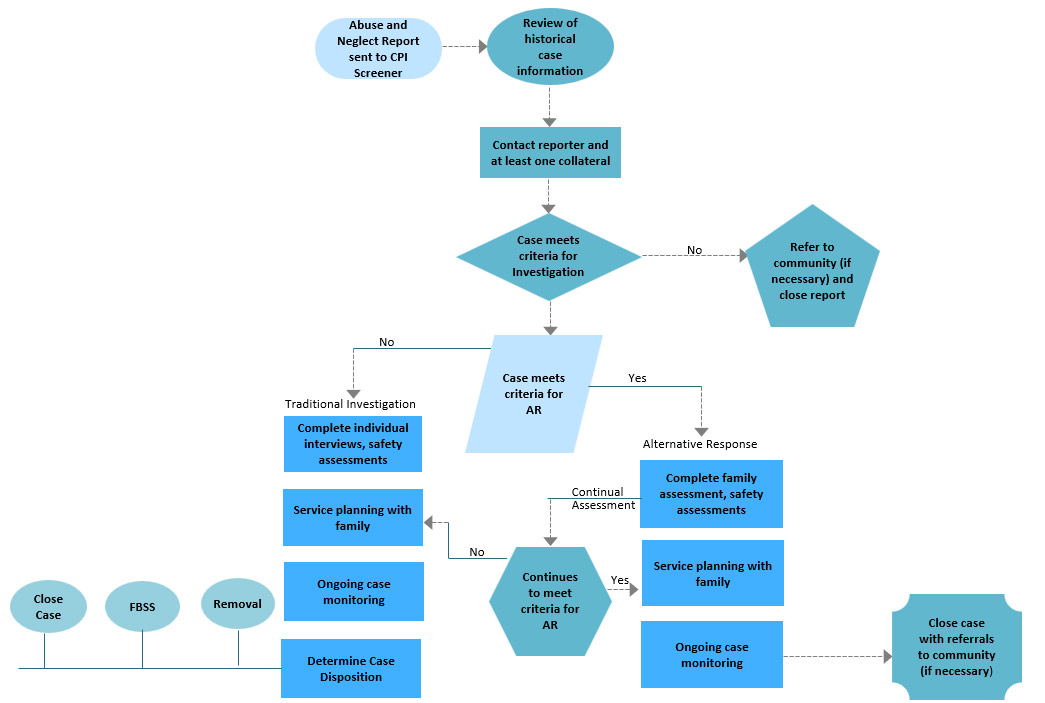 View the Alternative Response Model
Investigations with a child of any age can be screened for AR. Traditional pathway cases will now be under consideration for AR based on additional information at intake or after initial contact with the family.
Although most cases that DFPS receives meet the criteria for AR, some cases do not:
- Sexual Abuse
- Human Trafficking
- Child Fatality
- Serious physical abuse that requires a disposition
- AR investigations will be transitioned to a traditional investigation if more intervention is warranted
Goals for AR Advancement:
| Increase |
|
|---|---|
| Decrease |
|
 Instagram